Packing Cube Sizes Guide: Planning Sizes for a Product Line
Why size mix matters more than any single size
Most first-time packing cube programs start with one cube. On the sewing line, a single size is also the easiest to quote, cut, and pack. But retail buyers rarely reorder a one-size line. Customers pack different bag shapes, trip lengths, and garment types. A line with only a large cube misses the backpack customer. A line with only a small cube cannot hold bulky mid layers. The size mix is the product.
When we review a buyer's spec sheet, we look at the spread between the smallest and largest cube. A tight spread creates too much overlap in use. A wide spread gives the customer a reason to buy multiple pieces. In the A-4618 set, the dimensions step down in a way that keeps each size useful without turning the smaller cubes into scrap fabric exercises.
The A-4618 production set: four sizes, one construction
The A-4618 set uses nylon throughout and two-way YKK zippers. Keeping one material and one zipper type across all sizes reduces cutting errors, simplifies QC, and lets the sewing line hold consistent seam allowances from the XL to the S. A two-way zipper matters more on larger cubes because the opening needs to stay put when the cube is overfilled.
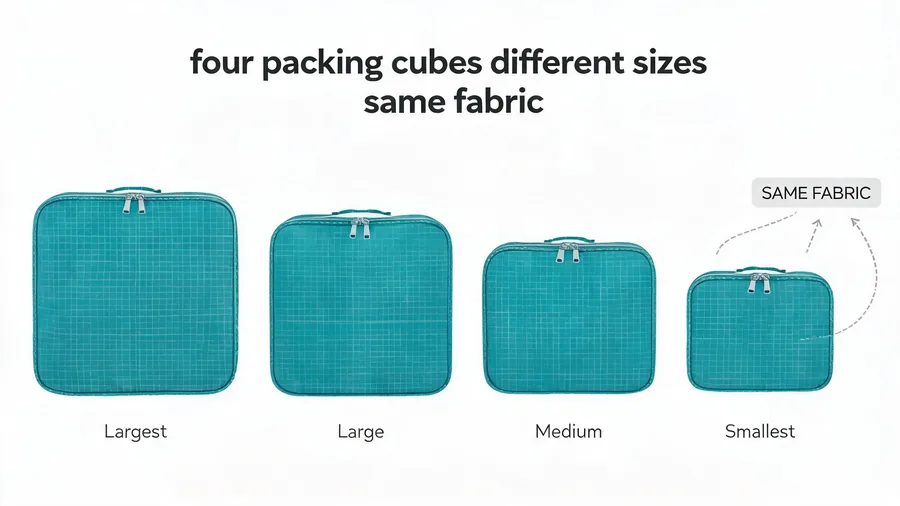
XL 16.5" x 12.6" x 4.7"
This is the checked luggage cube. It sits flat in the bottom of most large suitcases and works for bulky garment categories: jeans, sweaters, hoodies, towels, and puffy jackets. On the line, the XL uses the most fabric per unit and has the longest zipper run, so any fabric skew or zipper tension shows up first here. In QC, we load this size first because a seam under stress at the corner will fail faster than on the smaller panels.
L 13.5" x 11.5" x 4.7"
The L size is the general all-rounder. It handles trousers, long-sleeve shirts, light mid layers, and a full change of clothes without becoming a rigid block. It fits into the main compartment of many carry-on suitcases and also works in larger backpack main bodies. The depth is the same as the XL, so the packing height stays consistent. The smaller footprint makes it easier to slide beside shoes or a toiletry kit.
M 12.6" x 9.5" x 4.7"
The M size is the shirt and underwear cube. It suits folded t-shirts, shorts, socks, leggings, and children's garments. It is also the size we see most often in backpack side pockets and front compartments. Since it shares the same depth as the XL and L, the M cube can stack cleanly with larger cubes inside a suitcase without creating wasted channels.
S 11.5" x 8.4" x 4.2"
The S cube has a slightly shallower depth at 4.2" compared with 4.7" on the three larger sizes. That is a deliberate production choice. In a small cube, the shorter wall reduces the pucker around the zipper and keeps the cube from bulging in a backpack's outer pocket. Use it for electronics accessories, cords, socks, underwear, small garments, or a compact gym kit.
Depth is a packing decision, not an afterthought
Most buyers focus on length and width because those dimensions match the bag. Depth determines how the cube behaves when loaded. A shallow cube forces flat packing. A deep cube invites overfilling and then fights the zipper. In the A-4618 set, the three larger sizes share 4.7" of depth. This is enough to hold folded garments without turning the cube into a rigid box.
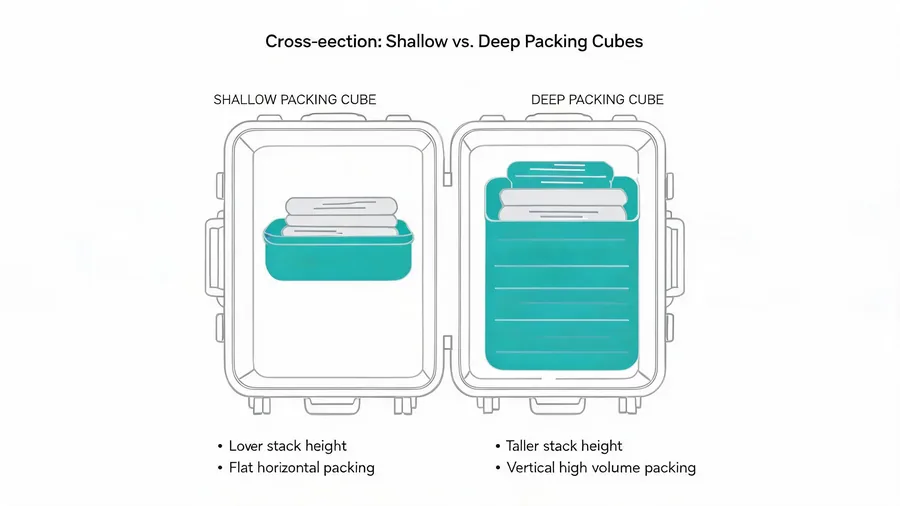
The S cube drops to 4.2" because small cubes sit in tighter places. On the sewing line, cutting the wall panel at 4.2" also changes the way the mesh top lies. A shorter wall means less top fabric is needed to reach the zipper line. The result is a flatter surface and fewer returns from zippers catching on the mesh.
Buyers should ask their factory about depth tolerance. A cube quoted as 4.7" deep will not always measure exactly 4.7" after the zipper is set. In QC, we measure depth from the base seam to the top zipper coil, not from the raw fabric edge.
Mapping cube sizes to luggage types
Size mapping is not about naming an airline. It is about the shape of the bag. Carry-on suitcases tend to have shallower main compartments, so flat, medium cubes work better than one tall cube. Checked luggage allows a taller stack and can absorb the XL. Backpacks need narrower footprints and less depth, especially in the front pocket.
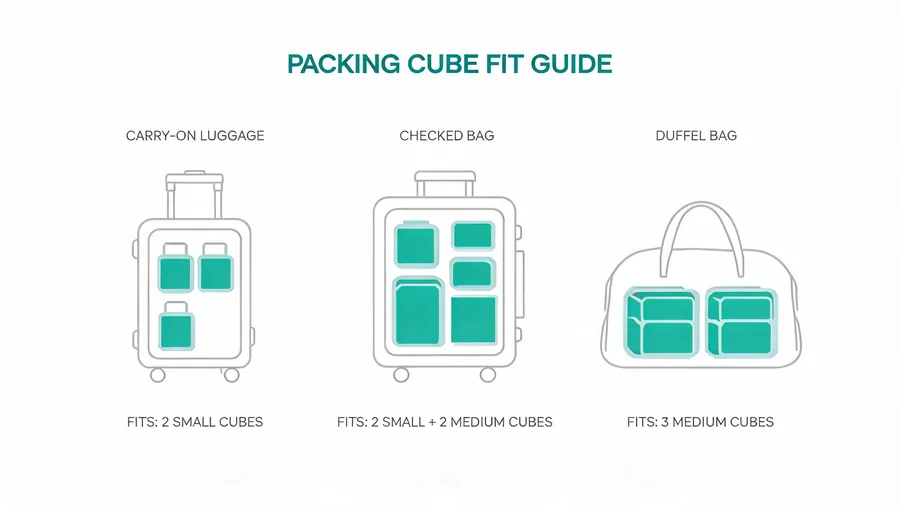
In general, the S and M sizes fit most backpack main compartments and outer pockets. The L works in a larger backpack or a carry-on suitcase. The XL is best in checked luggage or a duffel. A buyer planning a backpack-specific line should look at packing cubes for backpacks before locking dimensions, because a cube that fits a rolling bag may be too wide for a backpack's back panel.
For a mixed retail assortment, the A-4618 dimensions cover the range without producing a size that only works in one unusual bag. The S and M repeat well for carry-on customers. The XL becomes the add-on for checked luggage customers. That is healthier than trying to make one cube serve all three bag types.
| Size | Carry-on suitcase | Checked luggage | Backpack |
|---|---|---|---|
| XL | Rarely, only in large carry-on designs | Primary use | Too wide for most back panels |
| L | Main compartment | Stackable | Large main body |
| M | Main or top pocket | Stackable | Main or front pocket |
| S | Top pocket or accessory slot | Accessory cube | Front or side pocket |
Planning a 3-piece set vs a multi-piece set for retail
A three-piece set is easier to package and easier for a first order. The common retail split is S, M, and L. It gives a customer three stackable sizes without the bulk of the XL. However, a three-piece set leaves out the checked luggage user who wants one large cube for bulky garments.
A multi-piece set adds the XL or repeats a smaller size as a spare. Some buyers move to a larger set like a 9-piece travel organizer set when they want the product page to feel complete or when they are building a higher basket value. The trade-off on the factory side is that more pieces per set means more cutting tickets, more zipper lengths, and more individual QC checks. The sewing line can handle this, but the set must be planned so the same fabric and zipper type run across all pieces.
If a buyer asks about MOQs, the answer depends on fabric and construction. MOQs depend on fabric and construction, contact the factory. A three-piece set will have a different cutting plan than a multi-piece set, even when the individual cubes use the same material.
Labeling and colorway strategy per size
Labeling should be applied before the final top stitch, not as an afterthought. We usually recommend placing the size label on the webbing puller or the side seam, which keeps the top mesh clean and avoids stitching through the zipper chain. In QC, we check that the label matches the cut panel because an XL panel with an S label is a common error when the line changes sizes.
Colorway strategy works better when the sizes are visually separated by depth or by zipper color, not by a different material. If all four sizes use the same nylon and the same mesh, the factory can cut a colorway in a single run and reduce downtime. A common approach is to use one body color for the set and use the zipper pull color to identify each size. Another approach is to keep the same body color but use contrast binding on the S and M for quick recognition on a retail shelf.
Do not use a different fabric per size unless the product line is positioned as a mixed-bag look. That creates more testing, more cutting tables, and more chance of a shade mismatch across production runs.
Size table: A-4618 dimensions and typical use
| Size | Dimensions | Material | Zipper | Typical contents |
|---|---|---|---|---|
| XL | 16.5" x 12.6" x 4.7" | Nylon | Two-way YKK | Jeans, sweaters, hoodies, towels, outerwear |
| L | 13.5" x 11.5" x 4.7" | Nylon | Two-way YKK | Trousers, long-sleeve shirts, light mid layers |
| M | 12.6" x 9.5" x 4.7" | Nylon | Two-way YKK | Shirts, shorts, socks, leggings, children's garments |
| S | 11.5" x 8.4" x 4.2" | Nylon | Two-way YKK | Socks, underwear, accessories, small garments |
From sample to quote
When you have a size plan, send the dimensions and the intended set count. We review the cutting plan, fabric yield, zipper lengths, and packing method. If you need to start with a smaller set and grow into a wider line, the same patterns can extend into more pieces later.
For buyers planning a volume program, review packing cubes wholesale and include your target size mix in the quote request. We will ask about fabric, mesh, zipper type, set composition, and whether you want the S depth at 4.2" or matched to the larger cubes. That gives a cleaner production handoff from the first sample to final QC.
Put this into production
We build custom packing cubes from spec sheets exactly like the ones described above. Send yours and we reply within 24 hours.
Get a Quote