Compression Packing Cubes: A Manufacturer's Guide
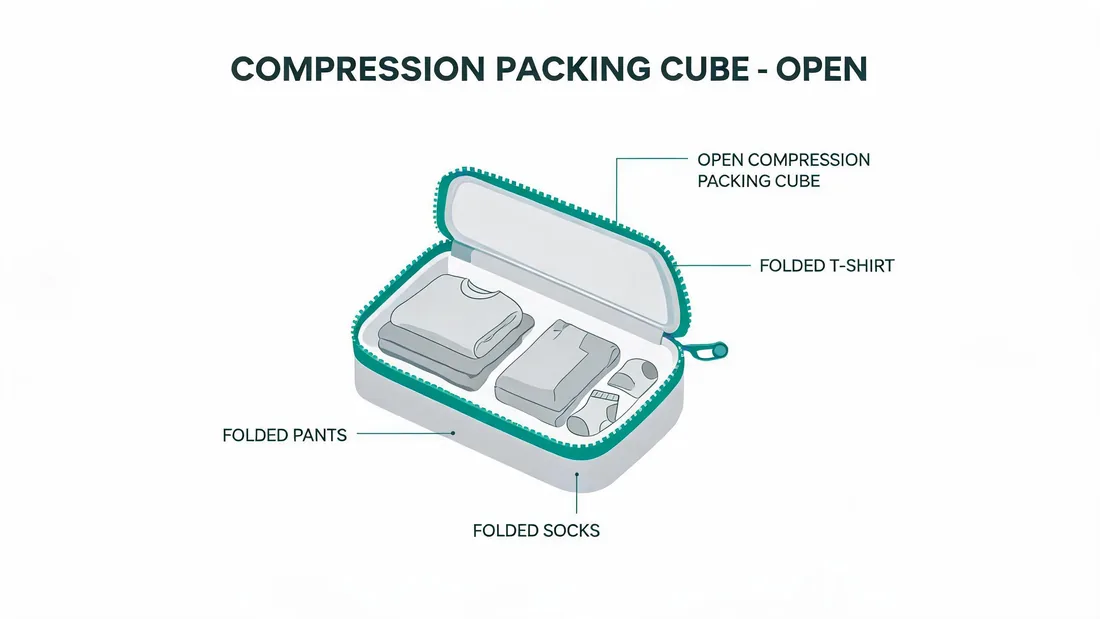
What a compression packing cube is
A compression packing cube is a fabric travel organizer with two separate zipper systems. The main zipper opens the top panel for packing. The compression zipper runs around the body or across the side and pulls the top and bottom panels closer after the cube is loaded. This is mechanical compression, not vacuum sealing. There is no air pump and the cube does not need to be airtight.
Buyers evaluating custom compression packing cubes often ask us where the extra pressure comes from. It comes from a folded fabric gusset and a second zipper. When the compression zipper closes, it takes up fabric that would otherwise remain open as depth. The result is a tighter pack and a smaller cube.
How the dual zipper mechanism works mechanically
On an open compression cube, the side gusset stands at full height. The main zipper keeps the cube closed while the compression zipper remains open. To compress, the user pulls the two compression sliders. The zipper brings two edges of the compression gusset together. As the teeth engage, the extra fabric folds inward like a sharp pleat. The top and bottom panels move toward each other and squeeze the load.
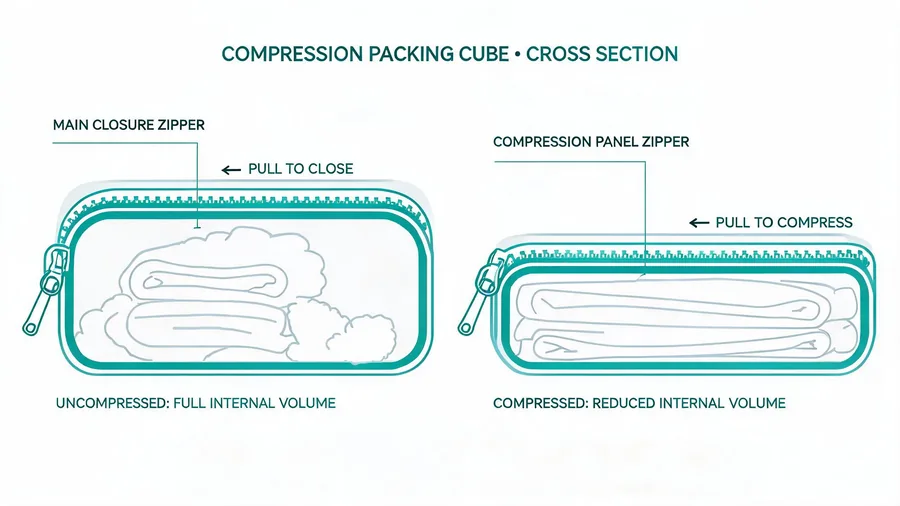
This works best when the cube is full enough to fill the expanded space but not so full that the panels are rigid. An underpacked cube can fold unevenly. An overpacked cube pushes the zipper tape outward and creates side load on the coil. We tell buyers to spec a compression zipper with wide tape and reinforced ends for this reason.
Panel and gusset construction
On the sewing line, a compression cube begins as a top panel, a bottom panel, a perimeter side gusset and a separate compression gusset strip. The top panel carries the main zipper opening. The side gusset sets the full depth. The compression gusset is sewn between two sections of the side wall or between the side wall and bottom panel, depending on the pattern.
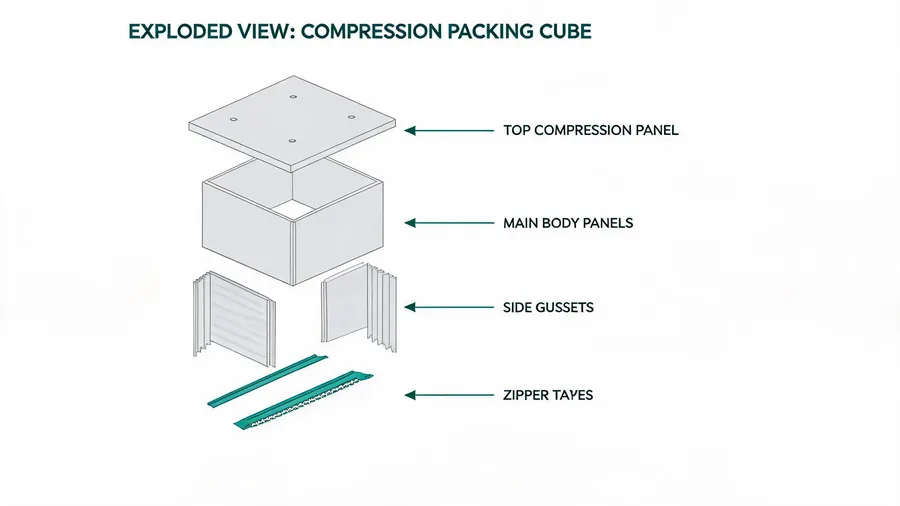
We box the corners and sew a bartack at each seam intersection. Binding covers the raw seam allowance. The compression zipper tape is stitched to both sides of the fold line. When the zipper is closed, the fold line is drawn inward and the cube becomes shallower.
Our production set A-4618 is a nested family of four sizes. The dimensions are:
| Size | Length | Width | Depth |
|---|---|---|---|
| XL | 16.5" | 12.6" | 4.7" |
| L | 13.5" | 11.5" | 4.7" |
| M | 12.6" | 9.5" | 4.7" |
| S | 11.5" | 8.4" | 4.2" |
This stock set uses nylon panels and two-way YKK zippers. Buyers can change body fabric, mesh layout and zipper tape based on their target price point. If you are still deciding which sizes to stock, use our packing cube size guide.
Which garments compress well and which do not
Soft textiles respond well to compression. T-shirts, underwear, socks, leggings, base layers, sports jerseys, shorts, fleece, sweaters, casual pants and towels all recover after pressure. These are the garments we use in factory load tests.
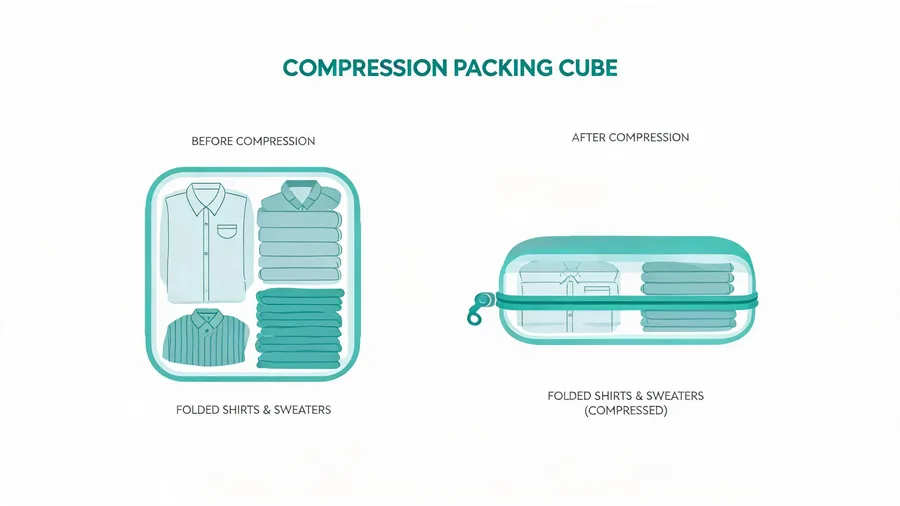
Structured garments do not compress well. Blazers, dress shirts, tailored trousers, hats, pleated skirts and anything with interfacing or shoulder pads can develop creases. Coated outerwear and stiff technical shells can fold poorly and may damage the coating. Denim and heavy cotton can be compressed but are dense, so the reduction in bulk is limited.
A compression cube is therefore a good fit for casual travel, family travel and gym use. It is not a solution for business formal packing.
Fabric and zipper selection trade offs
Nylon body fabric is strong, light and smooth, and it slides easily into luggage. It accepts a water resistant coating well and is a solid default for compression panels. Polyester is often more cost effective with good color consistency, but it can feel stiffer and may not fold as neatly in the compression gusset. rPET offers a recycled story and handles like polyester, but shade consistency should be checked at the sample stage.
Mesh panels give visibility and airflow. The trade off is tear strength. Mesh can rip at the stitch line if it is stretched too tight or if it sits too close to the compression zipper path. We prefer low stretch mesh with bound edges and keep mesh panels framed by solid fabric.
Compression zippers are usually coil zippers with two sliders. Coil chains tolerate repeated side load better than larger molded chains. Wide zipper tape gives more area for stitching and reduces pressure on the fabric edge. The sliders should move freely but not feel loose. A compression zipper should not be made with the lightest tape simply to save cost.
Water resistant coated fabric is useful on the main panels, but it can wear at fold lines over time. We avoid placing coated fabric inside the compression fold when possible.
QC failure points and how construction prevents them
Three failure points recur in compression cube QC: compression zipper burst, corner seam stress and mesh tears.
| QC failure | Common cause | Construction prevention |
|---|---|---|
| Compression zipper burst | Overpacking pushes the zipper tape outward and separates the coil from the fabric | Wide zipper tape, two stitch lines along each tape edge, bartacks at both zipper ends |
| Corner seam stress | Several panels meet at a boxed corner and seam allowance pulls apart under load | Bartack at each corner, bound seams, consistent seam allowance |
| Mesh tear | Low stretch or unbounded mesh snags near the slider and tears at the stitch line | Bind mesh edges, frame mesh with solid fabric, keep mesh away from the compression zipper path |
Zipper burst is usually not a broken slider. In our experience the failure is at the point where zipper tape is sewn to the panel. The side load from an overloaded cube can pull the tape off the fabric or force the coil out of alignment. Wide tape and two stitch lines spread that force. Bartacks at both ends stop the tape from peeling away.
Corner seam stress appears because the corner gathers the top panel, bottom panel, side gusset and compression gusset in one small area. A weak corner opens under load. We bind the seam and sew a bartack directly at the corner. On the QC table, we pull each corner by hand after the cube is packed.
Mesh tears often start at the stitch line. If the mesh is stretched during sewing, the needle holes can elongate and the panel fails later. We bind the mesh edge before topstitching and keep the mesh panel away from the compression zipper slider travel.
What to check on a pre production sample
A pre production sample should be inspected loaded, not just empty. We recommend this order:
- Measure the cube empty and compressed against the approved spec sheet.
- Open and close the main zipper and compression zipper several times. Look for rough spots and skipped stitches.
- Pack the cube with typical soft garments. Close the main zipper, then close the compression zipper.
- Check each corner under load. Pull the seam and see if the thread opens or the bartack shifts.
- Inspect the mesh from inside and outside. Look for loose edges, snags or wavy topstitching.
- Close the compression zipper from both directions. The two sliders should meet cleanly without catching fabric.
- Check the ends of the zipper tape. There should be a tape stop or bartack, not a raw cut edge.
If the compression zipper is hard to close when the cube is packed, stop and correct the pattern, seam allowance or zipper tape width before bulk fabric is cut.
When compression cubes are the right SKU for a travel brand
Compression cubes make sense for a brand selling carry on organization, backpacks, family travel or gym accessories. They give a clear point of difference from a standard packing cube and encourage customers to buy sets. Soft casual garments compress well, so the product matches what most leisure travelers pack.
They are less suitable for a business travel range built around dress shirts, suiting and structured garments. Compression adds weight, cost and complexity. If the product page or package insert does not explain the two zipper system clearly, the return risk is higher.
We usually advise brands to carry standard packing cubes as the core line and add compression cubes in the most popular sizes. For the category comparison, see our compression bags vs packing cubes article. If you are mapping out a size range, start with the packing cube size guide.
Request a production quote
If you have a target size range or want to start from our A-4618 set, send the dimensions, fabric direction and zipper preference. We can advise on construction, mesh layout, seam binding and packaging details. MOQs depend on fabric and construction, contact the factory.
The best compression cube is the one that survives repeated loading without burst zippers, corner tears or mesh failure. Ask for a pre production sample and inspect it loaded, not just empty.
Put this into production
We build custom packing cubes from spec sheets exactly like the ones described above. Send yours and we reply within 24 hours.
Get a Quote